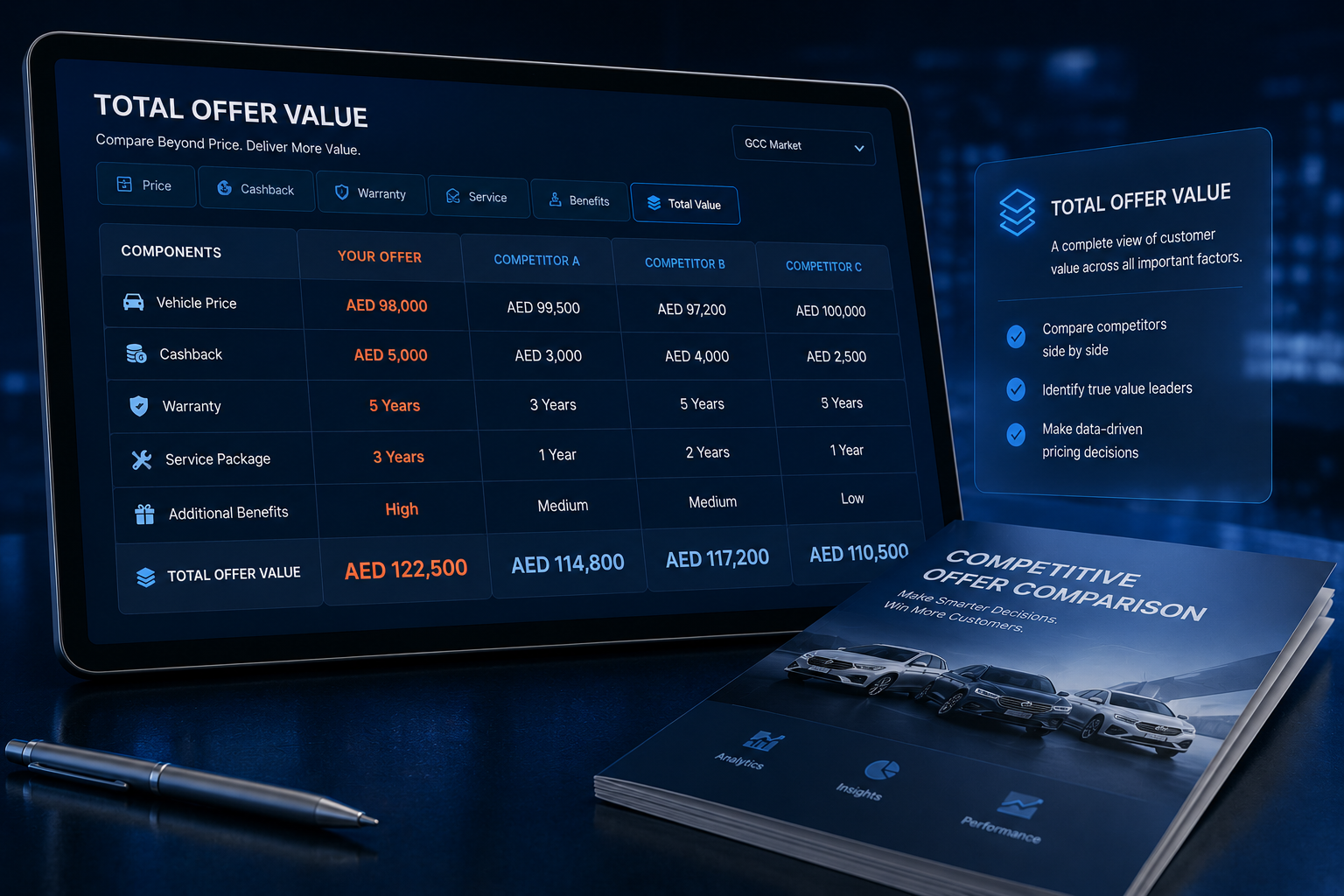
The lowest advertised vehicle price is not always the best deal. A car that costs slightly more upfront may include complimentary servicing, extended warranty coverage, insurance-related benefits, registration support or other incentives that add meaningful value to the complete offer.
This is where Total Offer Value provides a better way to compare vehicles. Instead of looking only at the number displayed beside the car, Total Offer Value considers the broader package being presented to the customer.
For car buyers, this creates a clearer way to evaluate competing offers. For OEMs, dealer groups, pricing teams and regional automotive leaders, it provides additional context for understanding how vehicles are actually positioned in the market.
Across GCC automotive markets such as the UAE, Saudi Arabia, Qatar and Kuwait, where vehicle promotions can include several different benefits, looking beyond headline price can make the comparison far more meaningful.
What Is Total Offer Value?
Total Offer Value is a structured way of evaluating a vehicle offer by considering the advertised vehicle price together with the financial and value-added benefits included in the proposition.
Those benefits can vary from one offer to another. Depending on the market, vehicle and promotion, they may include:
- Cashback or direct promotional discounts
- Complimentary service packages
- Extended warranty coverage
- Registration-related benefits
- Insurance-related benefits
- Roadside assistance
- Finance-related promotions
- Other dealer or OEM promotional benefits
The purpose is not simply to add as many benefits as possible. It is to understand the complete customer proposition instead of judging a vehicle using one number alone.
ALIA provides a dedicated Total Offer Value framework for examining automotive offers from this broader perspective.
Why the Lowest Vehicle Price May Not Be the Best Offer
Imagine a buyer comparing two similar SUVs.
Vehicle A is advertised at AED 120,000. Vehicle B is advertised at AED 124,000.
At first glance, Vehicle A appears to be the obvious choice because it is AED 4,000 cheaper.
But suppose Vehicle B includes a multi-year service package, additional warranty coverage and registration support. Vehicle A includes none of those benefits.
The AED 4,000 difference is still important, but it is no longer enough information to understand the complete comparison.
A lower advertised price can be attractive, but the strongest vehicle offer is better understood by looking at the complete customer proposition.
This is the basic idea behind Total Offer Value: move the comparison beyond headline price and examine what the customer actually receives as part of the offer.
What Should Be Included in a Total Offer Value Comparison?
A useful comparison starts by separating the major components of the vehicle offer. This prevents valuable benefits from being hidden inside general promotional language.
Vehicle Price
The advertised vehicle price remains the starting point. Total Offer Value does not make price irrelevant. Instead, it puts that price into context by considering the additional benefits surrounding it.
Cashback and Discounts
Direct discounts and cashback can materially affect the financial attractiveness of an offer. They should be identified separately so teams and customers can understand how the promotion changes the proposition.
Service and Maintenance Benefits
Complimentary servicing can add value beyond the purchase date. Where information is available, the duration and scope of the package should be considered rather than treating every service promotion as equivalent.
Warranty Coverage
Extended warranty coverage can influence the ownership proposition by providing additional support beyond the standard warranty period. Differences in warranty benefits can therefore matter when two vehicles are otherwise closely positioned.
Registration, Insurance and Other Benefits
Registration support, insurance-related promotions, roadside assistance and similar benefits may appear relatively small when viewed individually. Together, however, they can contribute meaningfully to the complete customer offer.
Price Comparison vs Total Offer Value
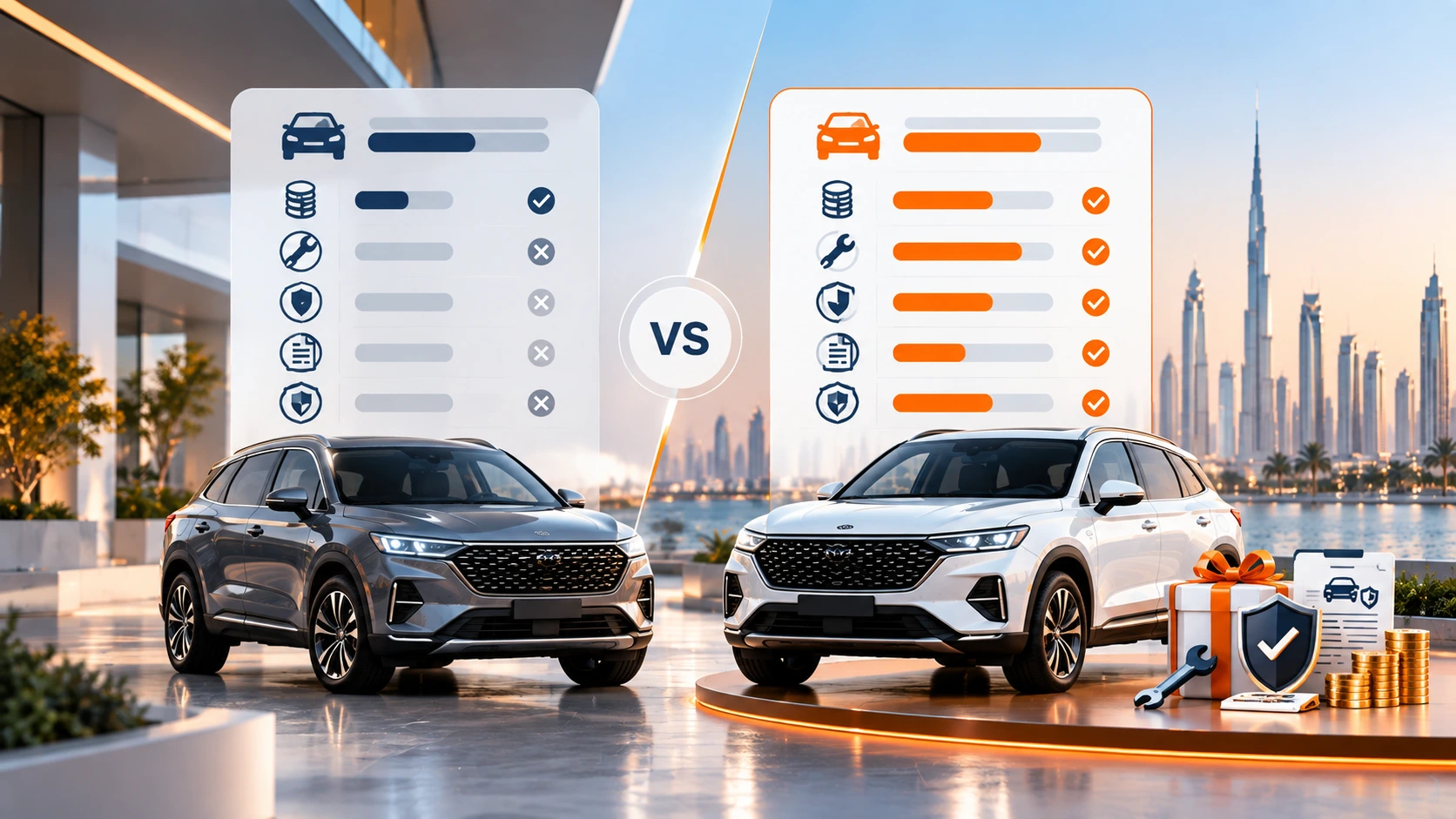
A traditional price comparison answers a straightforward question: Which vehicle has the lower advertised price?
Total Offer Value asks a broader question: What does the customer receive as part of the complete proposition?
Both questions are useful, but they serve different purposes.
Price comparison can quickly show how vehicles are positioned at the headline level. Total Offer Value adds the context needed to understand whether incentives and ownership benefits materially change that positioning.
Combining this perspective with Automotive Pricing Intelligence can give automotive teams a clearer understanding of how advertised prices and broader customer propositions are moving together.
Why Automotive Incentives Matter to Total Offer Value
Incentives are one of the main reasons headline price alone can create an incomplete comparison.
A manufacturer or dealer does not necessarily need to reduce the advertised vehicle price to strengthen an offer. It may introduce cashback, increase the duration of complimentary servicing, extend warranty coverage or add another customer benefit.
The vehicle price may remain unchanged while the complete proposition becomes more attractive.
This is why Automotive Incentive intelligence and Total Offer Value work naturally together. Incentive intelligence helps identify the individual benefits being offered, while Total Offer Value helps place those benefits within the wider customer proposition.
For a deeper explanation of how competing benefits should be evaluated, read our previous article, Automotive Incentive Comparison.
Total Offer Value Helps Compare Different Competitive Strategies
Competing automotive brands do not always use the same strategy to create customer value.
One brand may lead with aggressive promotional pricing. Another may protect the headline price while adding servicing and warranty benefits. A third may combine a moderate discount with several ownership-related incentives.
Looking only at price makes the first strategy easiest to see. Looking at Total Offer Value makes all three strategies easier to compare.
This matters for competitive intelligence because teams need to understand not only whether a competitor changed its price, but how the competitor changed its proposition.
Why Total Offer Value Matters Across GCC Automotive Markets
Automotive offers should also be understood within their local market. The UAE, Saudi Arabia, Qatar and Kuwait are connected regional markets, but promotional strategies and customer offers can vary between them.
The same vehicle may be positioned differently depending on the country, campaign or dealer. One market may emphasize service packages, while another may feature cashback, warranty support or another promotional benefit.
For regional automotive teams, a meaningful comparison therefore needs to retain market context.
It should be possible to understand which vehicle is being compared, where the offer is available, which benefits are included and how that proposition differs from relevant competitors.
This broader market perspective is explored in Automotive Market Intelligence for Smarter GCC Decisions, where we look at how pricing, incentives, competitive offers and dealer activity contribute to a clearer view of GCC automotive markets.
Dealer Offers Can Change the Comparison
OEM-level pricing is only part of the competitive environment. Dealer-specific activity can also change the proposition available to customers.
A dealer may introduce an additional benefit around a particular model, create a limited-period promotion or emphasize a different combination of incentives.
As a result, two vehicles that appear similarly positioned at a broader market level may look different once local dealer activity is taken into account.
Connecting Total Offer Value with Dealer Competitive Intelligence helps add this local competitive context.
How Total Offer Value Supports Better Automotive Decisions
Total Offer Value can be useful to several teams because it creates a common way to discuss the complete vehicle proposition.
Pricing Teams
Pricing teams can use the broader comparison to understand whether a competitor is relying on headline price, additional incentives or a combination of both.
Sales Teams
Sales teams can gain clearer context around why two similarly priced vehicles may present different levels of customer value.
Marketing Teams
Marketing teams can better understand which benefits competitors are emphasizing and how those benefits contribute to the overall proposition.
Regional and Dealer Leadership
Leadership teams can use a structured comparison to examine how offers differ between competitors, dealers and supported GCC markets.
Five Questions to Ask When Comparing Vehicle Offers
A practical Total Offer Value comparison can begin with five simple questions:
- What is the advertised vehicle price? Establish the starting point for the comparison.
- Which financial incentives are included? Identify cashback, discounts or other direct promotional benefits.
- Which ownership benefits are included? Look at servicing, warranty, registration, insurance-related benefits and other relevant components.
- How does the complete proposition compare? Evaluate the offer as a package rather than as a collection of disconnected promotions.
- Has the offer changed? Determine whether price, incentives or other benefits have been added, removed or modified.
These questions help move the discussion away from a simple lowest-price comparison and toward a more complete understanding of competitive value.
From Vehicle Price to Complete Offer Intelligence
Total Offer Value becomes even more useful when it is part of a broader automotive intelligence process.
A team may first identify a change in competitor activity, examine the new price or incentive, compare the complete proposition and then decide whether the change deserves commercial attention.
In simple terms: Observe → Compare → Understand → Decide.
The goal is not to automatically react to every offer in the market. Competitive intelligence provides context. Commercial teams still apply their own strategy, objectives and market knowledge when deciding what action, if any, is appropriate.
Learn more about the intelligence process on How ALIA Works.
A Better Way to Understand a Car Deal
Choosing or evaluating a vehicle offer based only on advertised price can overlook important parts of the proposition.
A slightly higher-priced vehicle may include meaningful benefits. A lower-priced vehicle may still be the stronger proposition. The important point is that the comparison should be based on enough information to understand the difference.
Total Offer Value creates that broader view by bringing vehicle price and relevant offer benefits into the same comparison.
For automotive teams across the UAE, Saudi Arabia, Qatar and Kuwait, this provides a more useful way to examine competitive offers and understand how customer value is being created across the market.
Explore Total Offer Value, discover How ALIA Works, or request a demo to learn more about ALIA automotive intelligence.