Automotive markets rarely stand still. A competitor can adjust the price of a vehicle, a dealer can introduce a new promotion, or a brand can strengthen an offer with additional servicing or warranty support. Each movement creates another signal for automotive teams to understand.
For organizations operating across several countries, following these changes becomes increasingly difficult. Pricing, incentives, dealer promotions and competing vehicle offers may be spread across different sources and presented in different formats.
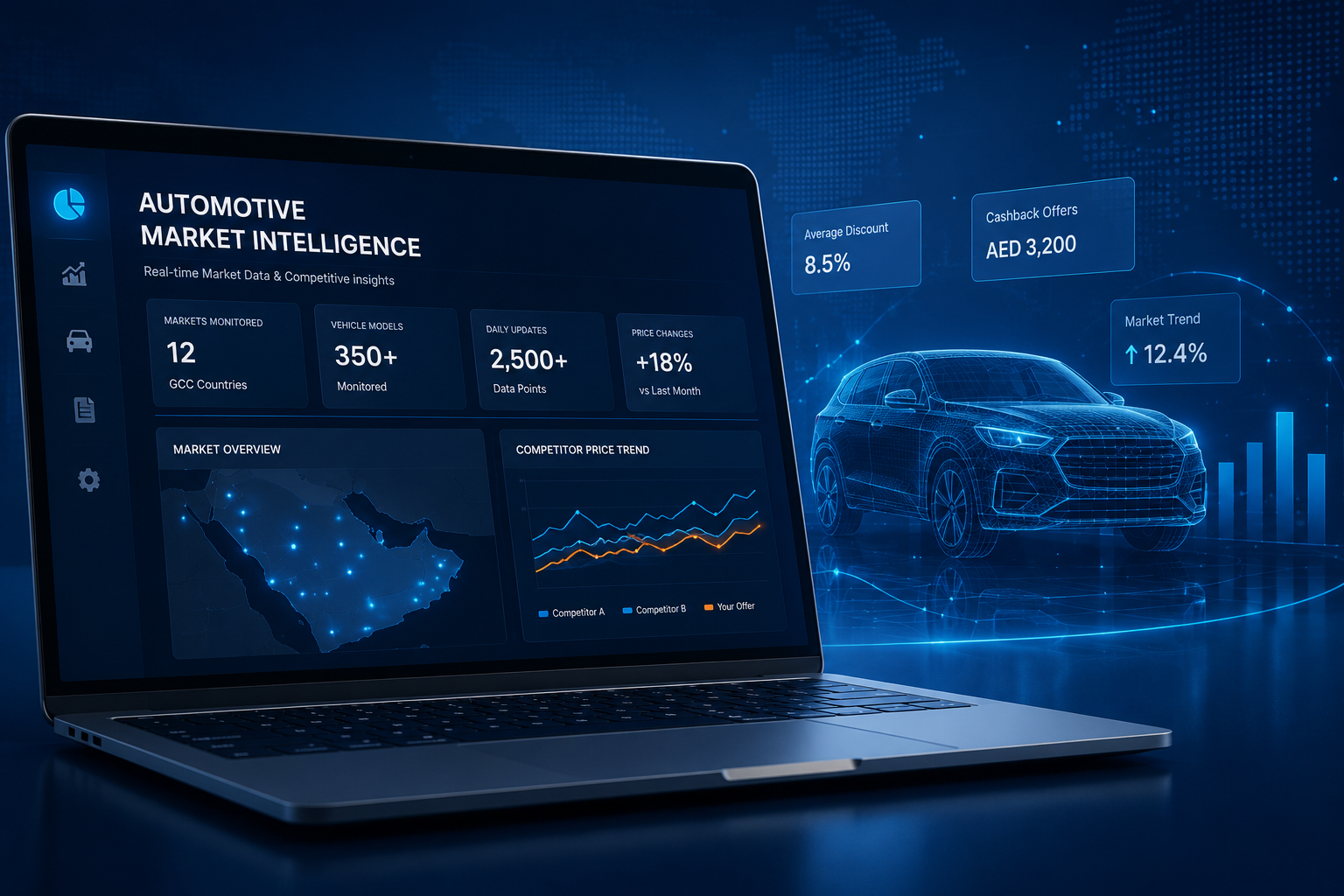
Automotive market intelligence brings these market signals into a more structured view. It helps OEMs, dealer groups, pricing teams, sales leaders and regional decision-makers understand what is changing in the competitive environment and where those changes are taking place.
This visibility is particularly valuable across GCC automotive markets such as the UAE, Saudi Arabia, Qatar and Kuwait, where pricing, incentives and dealer activity can vary from one market to another.
What Is Automotive Market Intelligence?
Automotive market intelligence is the structured collection, comparison and interpretation of vehicle pricing, incentives, competitive offers and dealer activity to support better-informed automotive business decisions.
It goes beyond collecting competitor prices. A useful intelligence process connects multiple market signals so teams can understand the context surrounding a competitive change.
For example, a price reduction becomes more meaningful when a team can also understand whether incentives changed, whether the promotion is limited to a particular dealer and whether similar activity is appearing elsewhere in the market.
Automotive market intelligence can help teams answer questions such as:
- Which competitors have changed vehicle pricing?
- Which models are receiving stronger promotional support?
- Have new incentives appeared in the market?
- Are dealers changing how particular vehicles are positioned?
- How does the current offer compare with relevant competitors?
- Is a change local or visible across several GCC markets?
Why GCC Automotive Markets Need Local Intelligence
The GCC is often discussed as one regional automotive market, but competitive conditions are not identical across every country.
The UAE, Saudi Arabia, Qatar and Kuwait can differ in vehicle availability, advertised pricing, promotional timing, incentive structures and dealer activity. An offer that appears in one country may not be available in another, even when the same vehicle is sold in both markets.
This means regional teams need both a broad GCC view and enough local detail to understand what is happening inside each individual market.
Good regional intelligence should therefore make it easier to identify where a change occurred, which vehicle or competitor is involved and whether the activity is isolated or part of a wider regional movement.
What Should Automotive Market Intelligence Track?
There is no single market signal that explains the entire competitive environment. Different teams need different information depending on the decisions they are making.
A structured automotive intelligence framework may monitor:
- Advertised vehicle prices
- Price increases and reductions
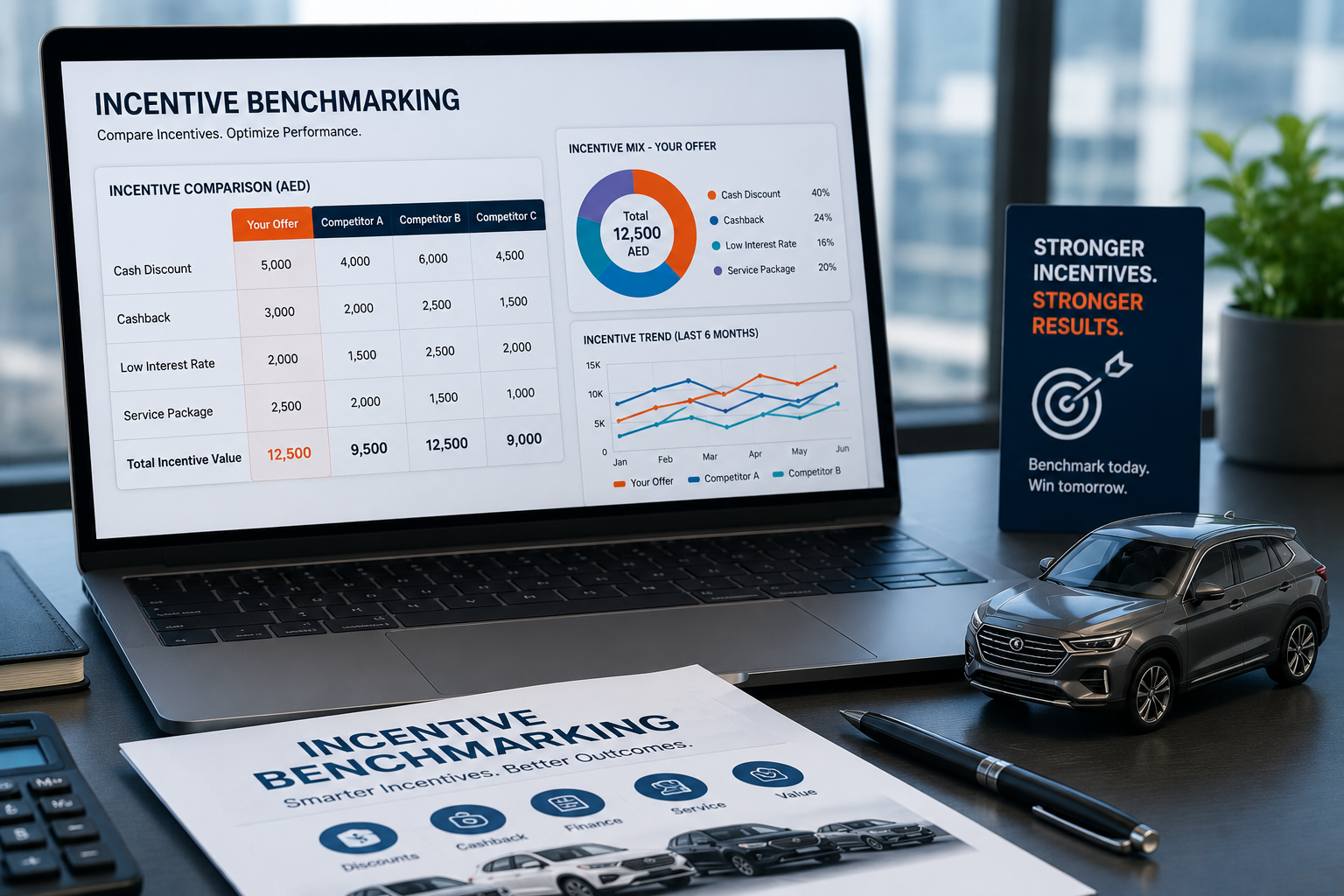
- Cashback and promotional discounts
- Service and maintenance packages
- Warranty benefits
- Registration-related offers
- Insurance-related promotions
- Dealer-specific campaigns
- OEM promotional activity
- Comparable competitor vehicles
- Changes in complete customer offers
The real value comes from connecting these signals. A pricing change, for example, becomes more useful when teams can see whether incentives or dealer activity changed at the same time.
Pricing Is Important, but It Is Only One Market Signal
Vehicle price is usually one of the easiest competitive signals to identify. It is also one of the easiest to compare.
However, knowing that a competitor reduced a vehicle price does not explain the complete market situation.
Teams may also need to understand whether the change is temporary, whether it applies across multiple dealers, whether incentives were adjusted and how the revised offer compares with other vehicles in the same competitive set.
Automotive Pricing Intelligence helps provide this additional pricing context by allowing market movements to be viewed as part of the wider competitive environment.
Incentives Can Change an Offer Without Changing Its Price
Some competitive movements never appear as a price change.
A vehicle may remain at the same advertised price while receiving cashback, complimentary servicing, extended warranty coverage, registration support or another promotional benefit.
From a price-only perspective, the offer appears unchanged. From the customer perspective, the proposition may now be considerably different.
This makes Automotive Incentive intelligence an important part of automotive market analysis.
For a deeper explanation of how these individual benefits can be compared, read Automotive Incentive Comparison.
Dealer Activity Adds Local Competitive Context
Regional market information can reveal broad competitive movements, but dealer activity often provides another important layer of detail.
Dealers may introduce local campaigns, place additional promotional support behind particular models or combine customer benefits in different ways.
This means two competing vehicles can appear similarly positioned at a regional level while being presented very differently within a local market.
Dealer Competitive Intelligence helps automotive teams examine this local competitive activity alongside the broader market view.
Market Changes Matter More Than Market Snapshots
A snapshot can show what offers are available today. Market intelligence becomes more useful when teams can also recognize what changed from the previous observation.
Consider a few examples:
- A competitor reduces the price of an important model.
- A two-year service package becomes a three-year package.
- A dealer introduces cashback for a limited campaign.
- Warranty support is removed from an existing offer.
- A particular model receives stronger promotional support.
- An offer appears in one GCC market but not another.
These changes provide more useful competitive signals than a long list of offers without historical or market context.
From Market Data to Useful Automotive Intelligence
Collecting more data does not automatically lead to better decisions. Automotive teams can monitor hundreds of offers and still struggle to understand which developments actually matter.
A useful intelligence process should make it easier to move through five stages:
Observe → Structure → Compare → Understand → Decide
Relevant market activity is first observed and organized into consistent categories. Comparable vehicles and offers can then be reviewed together so meaningful differences become easier to identify.
Once those differences are understood, commercial teams can decide whether a market movement requires further investigation or action.
Learn more about the intelligence workflow on How ALIA Works.
Understanding the Complete Vehicle Offer
Automotive market intelligence becomes more valuable when teams look beyond advertised price and examine the broader customer proposition.
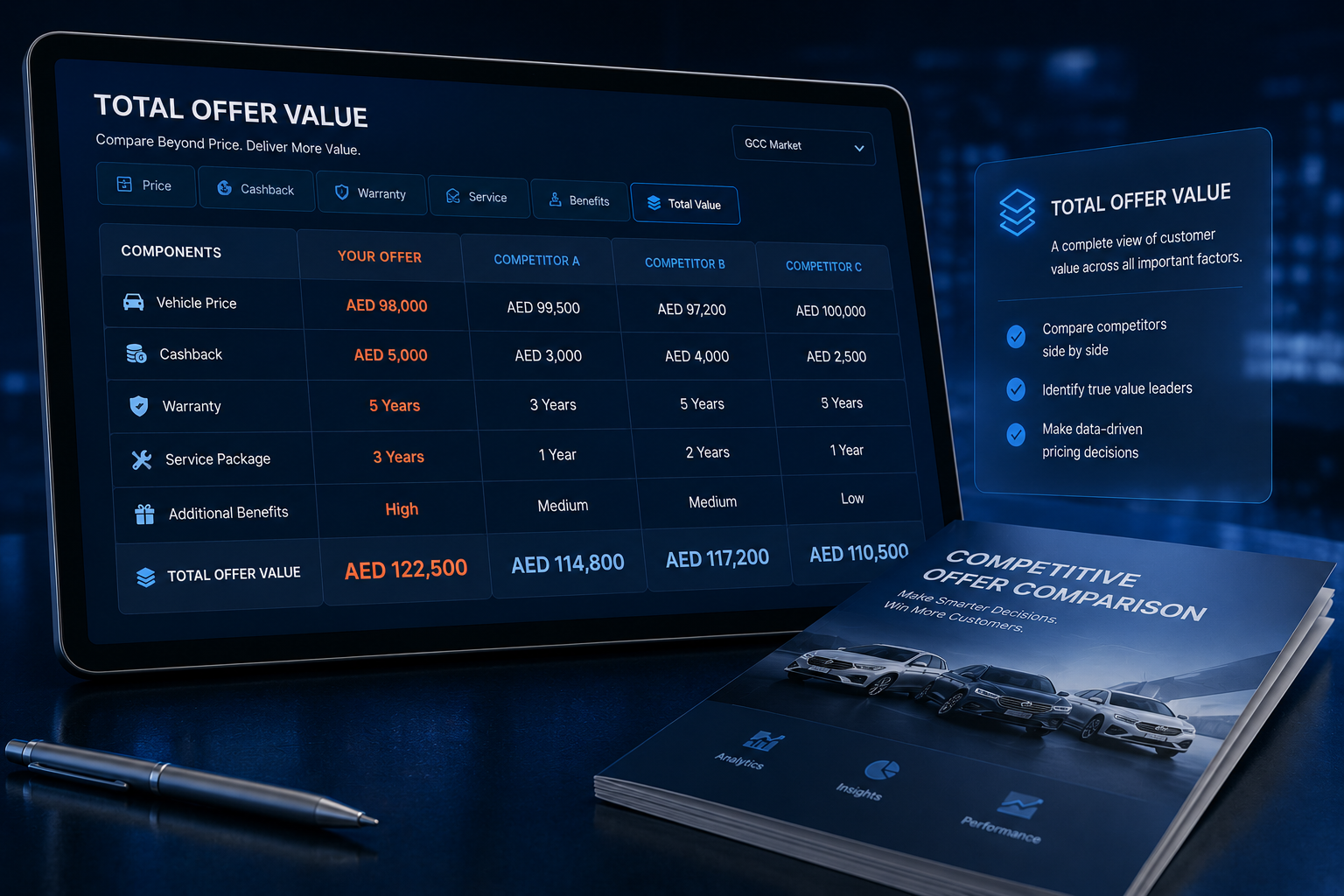
Two vehicles may have similar headline prices but very different combinations of cashback, servicing, warranty support and other benefits.
This is where Total Offer Value provides another useful layer of competitive context.
Instead of assuming that the lowest advertised price represents the strongest proposition, Total Offer Value helps teams consider the relevant components surrounding the vehicle price.
Read Total Offer Value: A Better Way to Buy A Car for a closer look at the difference between price comparison and the complete vehicle proposition.
Who Uses Automotive Market Intelligence?
The same market information can support several teams within an automotive organization. What changes is the business question each team needs to answer.
OEM and Regional Leadership
Regional leaders can use automotive market intelligence to maintain a broader view of competitive activity and understand whether significant movements are isolated to one market or appearing across several countries.
Pricing and Incentive Teams
Pricing teams can compare relevant vehicles and determine whether competitors are changing advertised prices, promotional benefits or a combination of both.
Sales Teams
Sales teams can use competitive context to understand how current vehicle offers are positioned against relevant alternatives in the market.
Dealer Management
Dealer management teams can examine local promotional activity and identify changes in how competing dealers are presenting vehicles and customer benefits.
Automotive Marketing Teams
Marketing teams can understand which models, benefits and promotional propositions competitors are emphasizing across different markets.
Five Questions Automotive Market Intelligence Should Answer
Market intelligence becomes more actionable when it helps teams answer a small number of practical questions.
- What changed? Identify the price, incentive, vehicle or dealer activity that moved.
- Where did it change? Understand the country, market or dealer associated with the movement.
- Which competitor or vehicle is involved? Keep the comparison focused on commercially relevant alternatives.
- How significant is the change? Consider the wider offer rather than evaluating one signal in isolation.
- Does the change require attention? Use the intelligence alongside commercial strategy and market knowledge to determine the appropriate response.
Better Intelligence Creates a Clearer Market View
The purpose of automotive market intelligence is not to create more spreadsheets, reports or dashboards. It is to reduce the effort required to understand the competitive environment.
When vehicle pricing, incentives, dealer activity and complete customer offers are organized into a consistent view, automotive teams can spend less time searching for information and more time understanding what the market is communicating.
For teams operating across the UAE, Saudi Arabia, Qatar and Kuwait, the strongest intelligence approach combines regional visibility with local market context.
The questions remain straightforward: What changed? Where did it change? How does the current offer compare? And which developments deserve attention?
ALIA brings relevant automotive market signals into a structured intelligence workflow to help OEMs, dealer groups and regional teams develop clearer competitive context.
Explore How ALIA Works, review Total Offer Value, or request a demo to learn more about ALIA automotive intelligence.